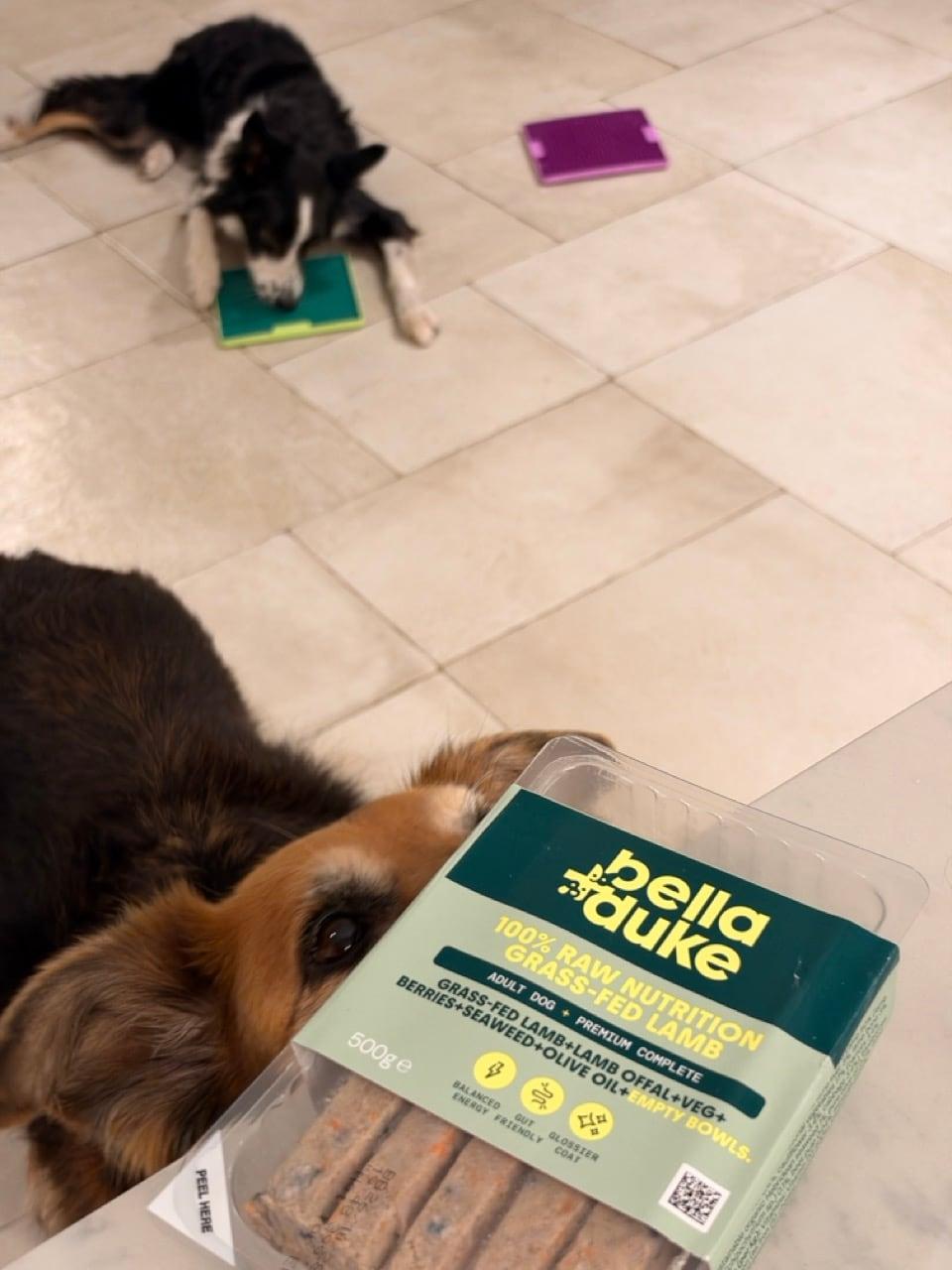
How much raw food to feed a dog: grams per day by weight
Most adult dogs eat 2% to 3% of their body weight in raw food each day. That’s the Royal Kennel Club’s guide, and it’s where every sensible portion starts. Below is a worked table by weight, how to choose where your dog sits in the range, and how to fine-tune it once you’ve started.
The 2–3% rule
As a guide, an adult dog eats 2% to 3% of its body weight in raw food a day. The Royal Kennel Club gives the example of a 10 kg dog eating 200 g to 300 g of raw food daily. It also says two things worth keeping in mind from day one: active dogs need to eat more, and you should speak to your vet first.
The percentage works because raw complete food is fairly consistent in how filling it is, and it scales neatly with size. It’s still a rule of thumb rather than a prescription. Two dogs of the same weight can need quite different amounts depending on age, activity, breed, whether they’re neutered, the weather and how they’re built. Think of the figure as where you start, and your dog’s waistline as what tells you whether to change it.
If you’d rather not do the sums, our raw feeding calculator takes your dog’s weight, age, activity and weight goal and gives you a daily amount in grams, per meal and per week, using the same guide.
Grams of raw food per day, by weight
Here is the daily amount at the bottom, middle and top of the range for common adult weights. The numbers are worked out from the Royal Kennel Club’s percentages, so they’re only as precise as the rule they come from:
| Dog’s weight | 2% a day (quieter) | 2.5% a day (typical) | 3% a day (very active) |
|---|---|---|---|
| 5 kg | 100 g | 125 g | 150 g |
| 10 kg | 200 g | 250 g | 300 g |
| 15 kg | 300 g | 375 g | 450 g |
| 20 kg | 400 g | 500 g | 600 g |
| 25 kg | 500 g | 625 g | 750 g |
| 30 kg | 600 g | 750 g | 900 g |
| 40 kg | 800 g | 1 kg | 1.2 kg |
These are daily totals for an adult dog, not per meal. If your dog falls between two rows, work it out directly: weight in kilograms, multiplied by 1,000, multiplied by the percentage, divided by 100. A 20 kg dog at 2.5% eats 500 g a day, which is 250 g a meal on two meals, or about 3.5 kg a week.
The weekly figure is the one to watch if you’re planning freezer space or comparing box sizes. Our guide to storing and defrosting raw food covers the freezer side, and raw dog food cost per day explains why bigger and busier dogs cost more to feed.
Where in the range should your dog sit?
Start in the middle for a typical adult with daily walks, move towards the top for a very active dog and towards the bottom for a quieter one. Then let your dog’s weight and body shape over the following weeks tell you whether to adjust.
- Towards 3%: working dogs, dogs that run for hours off-lead, young adult dogs with a lot of energy, and dogs that struggle to hold their weight. The Royal Kennel Club is clear that active dogs need to eat more.
- Around 2.5%: a healthy adult on one or two decent walks a day.
- Towards 2%: calmer dogs, dogs that gain weight easily, many neutered dogs and many older dogs that have slowed down.
Very small dogs can sometimes need a little more for their size, and very large, laid-back dogs a little less, but don’t guess at this. If your dog is at either end of the size scale, or has any health condition, it’s worth asking your vet for a starting figure. If you have a high-energy breed, our guide to raw feeding border collies and active dogs goes into more detail.
Your food producer’s own feeding guide matters too. Complete raw foods differ in fat content and recipe, so a brand may suggest a slightly different amount for your dog. Where your producer’s guide and the 2%–3% rule disagree, start with the producer’s figure for their food, and use your dog’s weight to settle it.
Feed for ideal weight, not current weight
Work out portions from the weight your dog should be, not the weight they are today. If your dog is overweight and you feed a percentage of their current weight, you’ll keep them overweight. If they’re underweight, you’ll keep them thin.
Your vet can tell you what a healthy weight looks like for your dog and show you how to check body condition by hand. As a general guide, you should be able to feel the ribs without pressing hard, and see a waist when you look down from above. If you’re trying to bring weight down or up, change the portion gradually rather than making a big jump, and weigh more often while you do.
Splitting meals, and why treats count
Most adult dogs do well on the daily amount split into two meals, morning and evening. Some owners feed once a day; that’s a choice to make with your vet, especially for large, deep-chested breeds. Puppies eat more often, which is one of the reasons they’re fed differently.
Everything your dog eats counts towards the daily total. Chews, training treats, bone broths, a bit of cheese for a tablet and the crust off your toast all add up. For a small dog, a couple of generous treats can be a surprising slice of the day’s food. If treats are a regular part of your dog’s day, trim meals a little to make room, and keep an eye on weight.
We feed Bella & Duke treats and chews alongside the main meals, and our guide to Bella & Duke treats and chews covers how treats fit around a raw diet.
Weigh, check and adjust
Weigh your dog every couple of weeks, especially in the first few months of raw feeding, and change portions in small steps. That’s the honest answer to “how much?”: the percentage gets you close, and the scales do the rest.
- Weigh the food. Use kitchen scales rather than eyeballing it, at least until you know what a portion looks like.
- Weigh the dog. Many vet practices let you pop in and use their scales. Small dogs can be weighed at home: weigh yourself holding the dog, then yourself alone.
- Adjust slowly. If weight is creeping up or down, change the daily amount a little and give it a couple of weeks before changing it again.
- Watch the dog too. Energy, body shape and how keen they are at mealtimes tell you as much as the number on the scales.
- Talk to your vet if weight changes quickly without a reason, or your dog seems unwell.
If you’re moving across from kibble, portion size is only half the picture. Our guide to switching from kibble to raw covers how to make the change gradually. And because raw meat can carry harmful bacteria (the Food Standards Agency found pathogens in 35% of raw pet food samples it tested), read our guide on whether raw dog food is safe before you start handling it every day.
Common portion mistakes
Most portion problems come from a handful of easy slips rather than from the percentage itself. These are the ones to watch for:
- Feeding the current weight of an overweight dog, which keeps the extra weight on.
- Forgetting the treats, so the meals are right but the day isn’t.
- Using the adult table for a puppy, which can leave a growing dog short.
- Changing too much at once, so you can’t tell what made the difference.
- Never re-checking: a dog’s needs shift with age, season and exercise, so the amount that was right a year ago may not be right now.
Puppies and older dogs are different
The 2%–3% guide is for adult dogs. Puppies are growing and need a puppy-specific complete food, fed in different amounts and more often. Don’t use the adult table for a puppy. Our guide to raw feeding puppies explains what changes and why your vet should be involved from the start.
Older dogs often need a little less as they slow down, though some lose weight with age and need more. Any change in appetite or weight in an older dog is worth a chat with your vet, rather than just changing the portion. There’s more in our guide to raw feeding senior dogs.
Pregnant and nursing dogs, and dogs with a medical condition, are outside this guide altogether. Their needs change quickly, and your vet should set the amount.
How it works with our two
Whatever you feed, start with the percentage, use the calculator if it helps, and adjust from there with your vet’s input.
A starting point, not veterinary advice. Ask your vet before changing your dog's diet, especially for puppies, pregnant or nursing dogs, or dogs with a health condition.
Frequently asked questions
How much raw food should I feed my dog a day?
As a guide, the Royal Kennel Club says 2% to 3% of your dog’s body weight in raw food each day. A 10 kg dog would eat about 200 g to 300 g a day. It is a starting point: speak to your vet first and adjust to your dog.
Should I use my dog’s current weight or ideal weight?
Use the weight your dog should be. If your dog is carrying extra weight or is underweight, feeding a percentage of the current weight keeps them where they are. Ask your vet what a healthy weight looks like for your dog.
Do active dogs need more raw food?
Yes. The Royal Kennel Club notes that active dogs need to eat more, so a very active dog usually sits towards the top of the 2% to 3% range, and a quieter dog towards the bottom.
Do treats count towards the daily amount?
They do. Chews, training treats and leftovers all add up, so take them into account when you weigh out meals, especially for a dog that puts weight on easily.
How often should I weigh my dog when raw feeding?
Every couple of weeks is a sensible rhythm, particularly in the first few months. Adjust the portion a little at a time if the weight is drifting, and talk to your vet if you are unsure.
Is the 2–3% guide right for puppies?
No. Puppies are growing and are fed differently from adult dogs, usually on a puppy-specific complete food. Follow your food producer’s puppy guidance and involve your vet.
Sources
- Royal Kennel Club: Is raw food good for dogs?
- Food Standards Agency: survey of contamination in raw dog and cat food on sale in the UK
Figures last checked 15 November 2026. If something has changed, tell us and we will correct it.
Related reading
- Feeding calculatorEnter your dog's weight, age, activity and weight goal for a daily raw food amount in grams, per meal and per week, using the Kennel Club's 2–3% guide.
- Switching to rawHow to switch a dog from kibble to raw food: a gradual or straight switch, what to expect in the first weeks and when to slow down.
- Raw for puppiesRaw feeding a puppy: why puppies need a puppy-specific complete food, how portions differ from adults and why to involve your vet.
- Cost per dayWhat raw dog food costs per day in the UK, why size and activity change the price, and how it compares with cooked and dry food.